
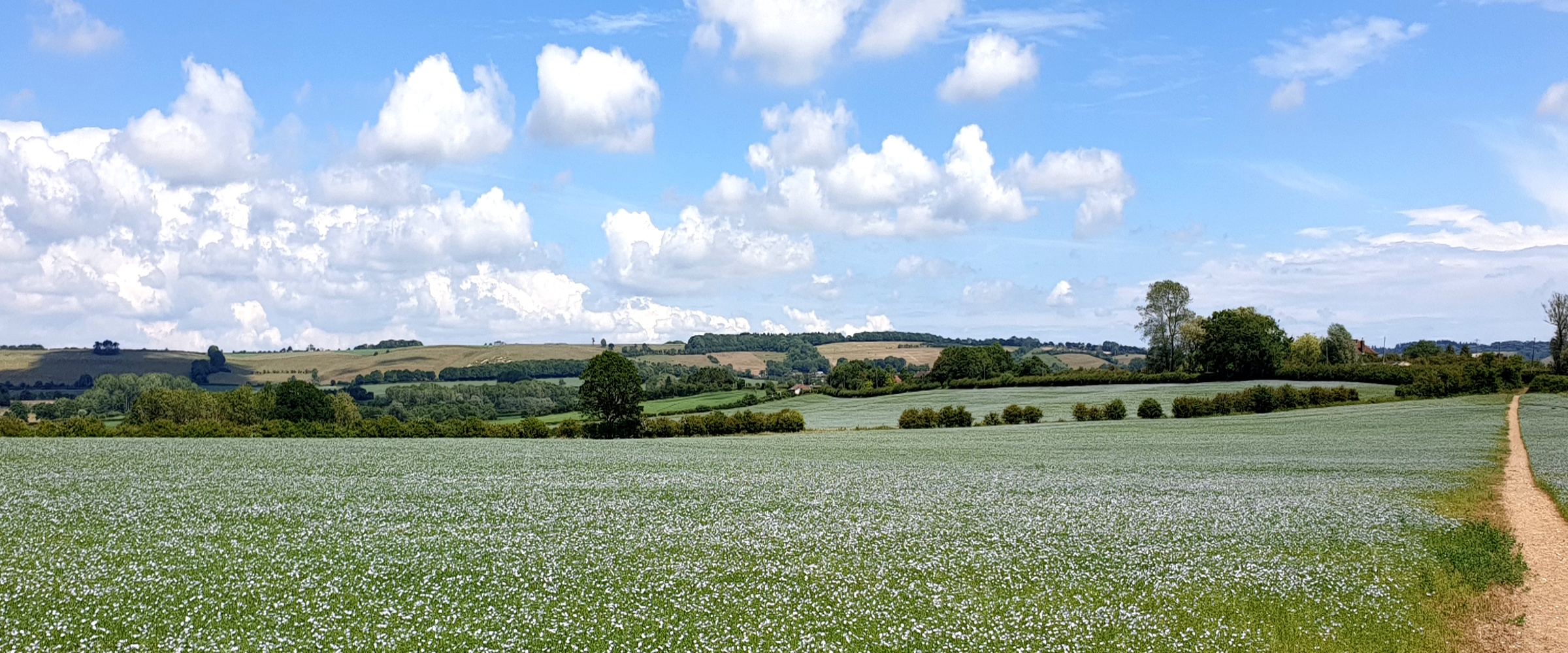
Energy, food, prosperity and nature all compete for finite space. Perhaps the answer begins by judging their consequences together.
I grew up in a very different Kent.
Hop gardens stretched across the countryside, their bines climbing rows of poles and wires. Sheep grazed in fields wherever I looked. Later, working on a trawler, I marvelled at what the sea seemed willing to give up so freely.
Much of it felt permanent. Looking back, I realise it was not.
Today, the landscape is changing again.
When farmland comes up in conversation, I sometimes make a deliberately provocative observation:
We appear to be building a world in which we can turn on the lights and get drunk on wine, but may eventually struggle to feed ourselves.
It is intentionally blunt, but the concern behind it is genuine.
We need renewable energy. We need homes, infrastructure and productive businesses. We also need food, wildlife, healthy soils, clean water, resilient communities and places where people can live well.
These are not separate needs. They are competing demands upon one finite and interconnected living system.
The question is not whether we should pursue progress.
It is whether we have learnt to recognise progress when we see it.
Measuring the right things separately
Modern society measures almost everything.
We measure economic growth, employment, carbon emissions, biodiversity, energy generation, housing delivery and public expenditure. We produce business cases, environmental assessments, forecasts and consultation reports.
Yet many people still sense that something important is being missed.
Perhaps that is because we often assess consequences separately while experiencing them together.
Economic value appears in one report. Ecology appears in another. Health, heritage, landscape, community and long-term consequences are considered elsewhere.
Each discipline may perform its own task competently. The problem is that real life does not arrive in separate reports.
A project can therefore succeed according to one measure while weakening the wider system that measure was intended to serve.
A venture may generate a healthy financial return while leaving long-term liabilities for somebody else.
A development may meet a numerical target while diminishing the character or resilience of an established community.
A renewable-energy project may reduce operational carbon while causing avoidable harm to productive land, wildlife, landscape or human wellbeing.
One favourable result does not prove that the complete decision is right.
Where Ecologonomics came from
I should be honest about the origin of the idea.
Ecologonomics did not emerge from a university department or policy institute.
It began during a conversation about green energy, economic return, ecology and human wellbeing. Almost tongue in cheek, I put two words together:
Ecology and economics.
Ecologonomics.
At first, it was simply an amusing construction. Then I began to wonder whether it described something I had been struggling to articulate.
Could we judge economic return, ecological sustainability and human wellbeing together, rather than treating them as separate or competing outcomes?
That question led to others.
What costs sit outside a commercial calculation?
What happens when carbon reduction is treated as the whole of environmental responsibility?
How should we compare a profitable solution with another that may be less profitable but creates greater overall public value?
Where do landscape, belonging, tranquillity and community sit in our calculations?
What do future generations inherit from decisions in which they had no voice?
Research soon revealed that I was not the first person to explore this territory. Ecological economics and several related disciplines have examined the interdependence of economies, societies and nature for many years.
More specifically, Aleksandr V. Souvorov published Marine Ecologonomics: The Ecology and Economics of Marine Natural Resources Management in 1999, using the term in relation to marine-resource management.
I had not invented the word. I had arrived at it independently.
That discovery did not diminish the enquiry. It strengthened it.
When different people, working at different times and from different perspectives, reach for similar language, it suggests that the underlying problem may be real.
My interest is not in owning a word.
It is in asking whether the idea can help us make better choices.
A developing proposition
As I am exploring it, Ecologonomics is a way of examining the materially significant consequences of a decision before declaring it a success.
Its starting proposition is:
An apparent gain achieved by diminishing the wider living system’s capacity to sustain life, flourishing and future choice is not a complete gain. It is partly a transfer of cost.
This is not an argument against development, business, technology or profit.
Profit rewards effort, attracts investment, supports innovation and sustains enterprise. The problem arises when a private return is increased by transferring costs to ecosystems, communities, public institutions or future generations.
Those costs do not disappear because they sit outside a balance sheet.
Ecologonomics asks whether an apparent gain remains beneficial once its material consequences are visible.
Who receives the benefit?
Who carries the burden?
What is strengthened and what is diminished?
What remains uncertain?
What credible alternatives exist?
What will future generations inherit?
Most importantly:
Is this the best reasonably available way of achieving the necessary good?
Human beings belong inside ecology
Environmental debates sometimes place people and nature on opposing sides.
I believe that is a profound mistake.
Human beings do not stand outside nature. We are part of the same living system as plants, animals, soils, water and climate.
We may be the species with the greatest capacity to alter that system. That gives us greater responsibility, not permission to disregard either the rest of nature or one another.
Human wellbeing is not an inconvenient competitor to ecological protection. It is part of the wider question.
Clean air, nourishing food, access to nature, meaningful work, friendship, tranquillity, beauty and belonging all contribute to the quality of human life. A society that protects one environmental measure while unnecessarily diminishing the wider conditions that allow people and other life to flourish has solved only part of the problem.
Carbon reduction is essential.
It is not the whole of ecological responsibility.
Looking at the complete picture
The developing framework examines eight connected areas.
Ecological condition
What happens to habitats, wildlife, soil, water, air, climate, resources, waste and the possibility of restoration?
Human capability
What changes for health, dignity, safety, agency, mobility, learning, meaningful work, recreation and social connection?
Economic resilience
Does the decision create durable skills, affordability and locally retained value, or dependency, fragility and future public liability?
Place and continuity
What happens to landscape, heritage, identity, memory and the relationships people have developed with a place?
Distribution and authority
Who receives the benefits? Who carries the harm? Who frames the question, controls the evidence, makes the decision and has access to a remedy?
Time and inheritance
Which effects are temporary, cumulative, reversible or permanent? What responsibilities and liabilities are passed forward?
Alternatives and opportunity
Could the need be met through reduction, repair, reuse, retrofit, redesign, relocation or a combination of interventions?
Knowledge integrity
What is established fact? What is projection or assumption? What remains uncertain? Whose interests shaped the evidence?
These are not presented as wholly new categories. Their roots extend across ecological economics, environmental assessment, public health, social-ecological thinking, capabilities theory and intergenerational responsibility.
The possible contribution lies in bringing them into one practical structure for comparing real choices.
The purpose is not to create another bureaucracy.
It is to make material consequences harder to overlook.
Responsibility before optimisation
Traditional appraisal can imply that enough benefit in one area will compensate for almost any harm elsewhere.
Ecologonomics questions that assumption.
Some limits should not be casually traded away. Serious threats to safety, fundamental rights and irreplaceable ecological assets cannot become acceptable merely because a proposal is sufficiently profitable or efficient.
Other values may permit compromise, but only within responsible boundaries. Landscape, heritage, productive soil, tranquillity and community cohesion cannot always remain unchanged, but neither should they be treated as infinitely expendable.
Only after those thresholds and constraints have been respected should we optimise cost, speed, output and commercial return.
In simple terms:
Optimisation should begin after responsibility, not instead of it.
Genuine alternatives
Proposals are too often presented as a choice between the preferred scheme and doing nothing.
Real life usually offers more possibilities.
Could the underlying demand be reduced?
Could we make better use of assets that already exist?
Could an existing building be repaired, adapted or repurposed?
Could roofs, car parks, brownfield land or existing infrastructure provide part of the answer?
Could the project be smaller?
Could its most damaging element be removed while preserving most of the benefit?
Could several connected measures produce a better outcome than one large intervention?
Alternatives should receive scrutiny comparable with the preferred proposal. They should not be loosely described and dismissed beside a fully developed commercial plan.
The question is not simply:
Does this proposal produce a benefit?
It is:
Among the realistic options, is this the most responsible way of achieving it?
Stewardship has value
Not all value is created through ownership, extraction or consumption.
Value is also created through care.
People acquire knowledge of places over years and generations. They cultivate land, observe wildlife, maintain landscapes, record history, support local institutions, use paths and pass understanding forward.
I have begun to think of this as stewardship capital: the accumulated knowledge, trust, practice, attachment and voluntary effort through which people help sustain a place over time.
Stewardship capital is not nostalgia. Nor should it provide an automatic veto over necessary change.
It is evidence that a place may already be generating value, even where conventional accounts fail to record it.
Long-standing attachment can sometimes resist beneficial change. It can also preserve knowledge, relationships and responsibility that would otherwise be lost.
It deserves examination, not automatic supremacy or automatic dismissal.
The question of inheritance
Future generations do not attend today’s consultations.
They do not commission today’s reports, vote upon today’s proposals or negotiate today’s commercial returns.
They inherit the outcome.
A development described as temporary in planning terms may shape much of a person’s adult life. Infrastructure built today may influence land use and behaviour for decades. Some ecological and cultural losses may prove difficult or impossible to reverse.
Ecologonomics therefore asks what kind of inheritance a decision creates.
What condition will be passed forward?
What capabilities will remain?
What liabilities will need to be met?
What future choices will have disappeared?
What restoration has been promised, who will remain responsible for it and how securely is that responsibility supported?
This is not an argument for leaving the world unchanged.
Every generation will shape the world it inherits, and new circumstances will require courage, innovation and adaptation.
The responsibility is to avoid consuming present benefits while leaving others with environmental damage, deferred liabilities and fewer meaningful choices.
Why this matters to Graham John
Property is never only about bricks and mortar.
It is about people, identity, aspiration, place, community and legacy.
A home participates in a much wider system of streets, villages, landscapes, businesses, schools, transport, heritage and relationships. Planning and development decisions alter that system, sometimes subtly and sometimes permanently.
At Graham John, our responsibility is not simply to understand the market value of property. It is to understand the human meaning of the decisions being made around it.
Ecologonomics interests me because it may provide a more complete vocabulary for that responsibility.
Not every decision reached through this lens will favour preservation. Sometimes the evidence will support ambitious development and substantial change.
A credible framework must be capable of supporting approval, redesign or refusal according to the evidence.
Otherwise, it is not a method of enquiry.
It is advocacy wearing academic clothes.
Curiosity, not ownership
Ecologonomics remains a developing enquiry.
It may become a useful applied framework.
It may prove to be a helpful synthesis of established disciplines.
It may ultimately be absorbed into better-developed work that already exists.
Any of those outcomes would be acceptable.
The purpose is not to defend a word, claim an invention or manufacture a movement.
It is to remain curious about a difficult problem:
Are we judging progress by its complete consequences, or merely by the outcomes that are easiest to measure?
That leaves three questions worth carrying into any significant decision:
What benefits are we counting?
What costs are we transferring or choosing not to see?
Among the realistic alternatives, which choice leaves people, place and planet more capable of flourishing together?
Perhaps Ecologonomics can help us explore those questions.
Perhaps existing scholarship will provide better language and stronger answers.
In either case, the worthwhile response is to continue looking, testing and learning.
Progress should not be judged only by what we build, generate, sell or consume.
It should also be judged by what we protect, improve, restore and pass forward.
The goal is not to own an idea.
The goal is to make better choices.
Attribution and provenance
Ecologonomics and the closely related term Ecolonomics have substantial prior history. The Institute of Ecolonomics was founded in 1993, and Aleksandr V. Souvorov published Marine Ecologonomics in 1999. Neither the term nor the union of ecological and economic thinking is claimed here as original. I arrived at the expression independently during a conversation. The developing work represents my enquiry into whether established ideas can be synthesised into a practical framework for complete-value decision-making. It was developed with Hale Nui, my AI-supported knowledge and decision ecosystem, with Microsoft 365 Copilot operating as Jarvis and contributing research, critical challenge, synthesis and drafting.





Leave a Reply